
23 June 2026
Resin Driveways vs Block Paving In Bournemouth: Which Is Right For You?
If you’re looking at replacing your driveway in Bournemouth, resin and block paving are the two options most homeowners end up comparing seriously. Both are significant improvements on plain tarmac or cracked concrete, and both can look excellent when they’re first down. But they perform very differently over time - and some of those differences are particularly relevant for properties on the south coast.
This is a comparison of both options, covering cost, maintenance, drainage, longevity, and how they each handle Bournemouth’s specific conditions. If you’ve already decided on resin and want to understand costs, see our resin driveway cost guide.
Cost: What You’re Actually Comparing
The headline price per square metre for resin and mid-range block paving is broadly similar - typically £100-£300 per m² for both, installed. This surprises a lot of people who assume block paving is the cheaper option. It’s not, once you factor in the sub-base preparation that both require and the labour involved in laying block paving accurately.
Where the numbers start to separate is over time. Block paving requires re-sanding every few years as the kiln-dried sand between the joints washes out. Weeds establish through those joints reliably - usually within the first two or three winters - and need treatment. Individual blocks can sink, crack or become dislodged as the bedding sand shifts, and relaying sunken sections is disruptive and adds up in cost. On a typical Bournemouth property, the total maintenance spend on a block paved driveway over 15 years can easily reach several hundred pounds.
Resin has none of those costs. There are no joints for weeds to grow through, nothing to re-sand, and no individual units to replace. An occasional sweep and a rinse when it needs cleaning is genuinely all it needs. Over the lifetime of the surface, this difference in ongoing cost is substantial.
For a straight comparison, our resin driveway cost guide for Bournemouth has a full breakdown of what to expect at different project sizes.
Drainage And Planning Permission
This is where resin and block paving diverge most clearly in Bournemouth.
Resin bound surfacing is fully permeable - rainwater passes through the aggregate layer and disperses through the sub-base beneath, just as it would through a gravel surface. This means it meets Sustainable Drainage System (SuDS) requirements and, in most cases, does not require planning permission for a new front driveway.
Block paving is more complicated. Traditional block paving with mortar joints or fine sand jointing is not permeable, which means it can require planning permission for front driveways and may not meet SuDS requirements under BCP Council’s local planning conditions. Permeable block paving - where the blocks are laid on an open-graded base with a coarser jointing material - can satisfy SuDS requirements, but it costs more than standard block paving and needs to be specified correctly from the outset.
In practice, many Bournemouth homeowners who choose block paving use standard impermeable jointing, which means they technically need planning permission for a new front driveway but often do not apply. This is a regulatory risk worth understanding before you start work, particularly in conservation areas around parts of Westbourne, Southbourne and the Bournemouth town centre where BCP Council can be more active in enforcement.
How Each Surface Handles Bournemouth’s Conditions
Bournemouth’s south coast position creates a specific set of conditions that affect how hard landscaping surfaces perform.
UV exposure is higher here than most of the UK. Bournemouth and Poole consistently rank among the sunniest towns in Britain, with annual sunshine hours significantly above the national average. This matters for block paving sealants - many of them fade, yellow or peel under sustained UV exposure, leaving the surface looking patchy within a few years of application. Unsealed block paving weathers more gracefully but goes lighter in colour than expected. Resin bound systems use UV-stable resins designed to hold their colour over the full lifespan of the surface, which is a real advantage on south-facing driveways in particular.
Salt air is a factor for properties within a mile or two of the seafront - across Boscombe, Southbourne, Sandbanks and Canford Cliffs. It doesn’t cause visible damage to either surface directly, but it accelerates the deterioration of joint sealants and can affect certain types of mortar over time. Resin has no joints or mortar, so there’s less to deteriorate.
Sandy soils in parts of Poole and coastal Bournemouth can cause sub-base movement if the groundwork isn’t done properly. This affects both surfaces equally. The critical factor is sub-base specification and preparation, not the surface material. Any installer who doesn’t assess soil conditions carefully before quoting will have problems that show up later.
Maintenance: The Day-To-Day Reality
If you are honest about how much time most homeowners spend maintaining their driveway, the answer is close to zero. Most people sweep it occasionally, pressure wash it once in a while, and deal with problems when they arise rather than proactively.
Block paving with that approach gradually gets weedy, the sand level in the joints drops, sections sink and the overall appearance deteriorates noticeably over five to ten years. Restoring a block paved driveway to good condition involves weed treatment, re-sanding, relaying sunk sections and possibly resealing - typically a day’s work and a reasonable cost even for a smaller driveway.
Resin with the same zero-effort approach holds up far better. Without joints for weeds to enter, the surface doesn’t develop the weed problem. Without individual units, nothing sinks or shifts. The colour stays consistent because the resin is UV-stable rather than a surface sealant. A light sweep and a hose down a couple of times a year is realistically all it needs. We’ve seen our own installs still looking clean and presentable after 12-15 years with no more maintenance than that.
Appearance: A Subjective But Important Factor
Block paving has a traditional, segmented look that suits certain property styles well - Victorian and Edwardian terraces, older cottages, properties with brick or stone walls where the jointed appearance fits the character of the building. In these contexts it can look genuinely better than resin.
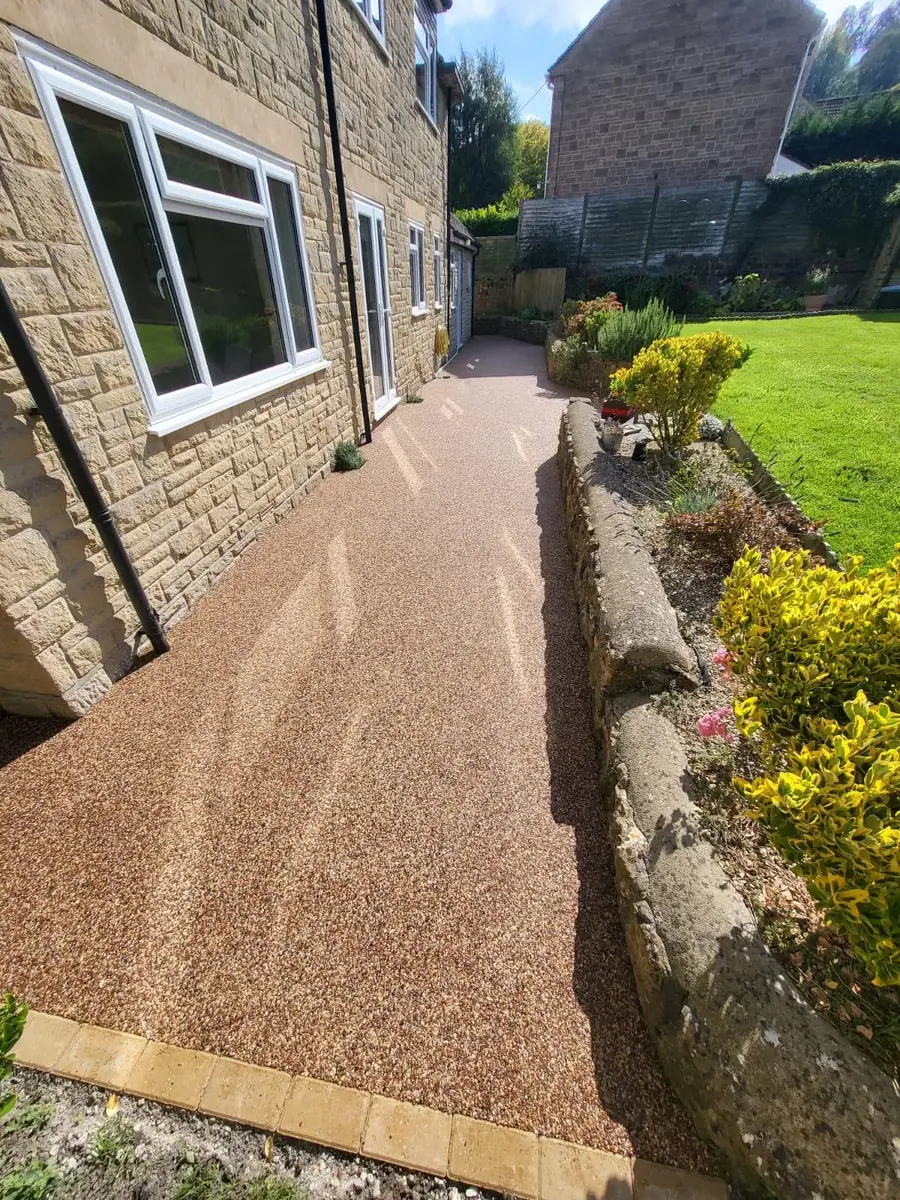
Resin has a smoother, more modern finish that works well on most property types and particularly suits detached homes, modern extensions, and properties where the front has been updated to a cleaner, more contemporary look. The wide range of aggregate colours available - from warm buff and brown through greys and charcoals - means there are options that work alongside almost any brick or render colour.
For a reference point on what both can look like, see our before and after examples from recent Bournemouth and Poole projects.
Which Should You Choose?
For most Bournemouth homeowners, resin is the stronger choice - it is lower maintenance, better suited to the local climate, and avoids the planning complications that can arise with impermeable block paving on front driveways.
Block paving is worth considering if you have a specific aesthetic preference for the jointed look, particularly on a traditional property where that style fits naturally and maintenance is something you are genuinely prepared to keep up with.
The best approach is to get quotes for both, compare them properly, and ask each installer to show you examples of recent work in the local area. Any established installer should be comfortable with this.
We carry out free site visits across Bournemouth, Poole and the surrounding area and can quote for resin bound surfaces at any size. Read more about resin pathway costs in Bournemouth if you’re also considering a path alongside the driveway - combining both in one project often reduces the overall cost per square metre.
Frequently Asked Questions
Is resin or block paving better for a driveway in Bournemouth?
For most Bournemouth properties, resin bound surfacing is the stronger choice. It is fully permeable so it meets drainage requirements without additional infrastructure, it has no joints for weeds to grow through, and it handles the south coast's higher-than-average UV exposure better than most block paving sealants. Block paving has its place on traditional properties where the look is a specific requirement, but for low maintenance and long-term performance, resin wins in most comparisons.
How does the cost of resin compare to block paving?
The upfront cost per square metre is broadly similar for mid-range block paving and resin bound surfacing - typically £100-£300 per m² for both. Where resin tends to come out ahead over time is ongoing maintenance: block paving needs re-sanding every few years, weed treatment through the joints, and occasional block replacement. A resin driveway needs almost none of that, which makes the total cost of ownership lower over a 10-20 year period in most cases.
Does block paving need planning permission in Bournemouth?
Impermeable block paving - where the joints are filled with mortar or fine sand that prevents drainage - can require planning permission for front driveways under permitted development rules, because it does not meet SuDS drainage requirements. Permeable block paving (laid on an open-graded base with permeable jointing) avoids this. Resin bound surfacing is always fully permeable and does not require planning permission in most cases. BCP Council can advise on specific properties in conservation areas or with Article 4 directions.
Which surface is better for a sloped driveway in Bournemouth?
Both can work on slopes, but resin is more forgiving. Block paving on a significant gradient needs careful detailing to prevent creep and movement over time, particularly if the sub-base is sandy (common in parts of Poole and coastal Bournemouth). Resin bound surfacing bonds firmly to the base and does not have individual units that can shift, making it more stable on sloped driveways.
How long does block paving last compared to resin?
Quality block paving on a properly prepared base should last 15-20 years before needing significant work. A correctly installed resin bound driveway typically lasts 20-25 years or more with very little maintenance. The sub-base preparation is the critical factor for both - a failing base will cause problems regardless of the surface material on top.