
1 August 2026
Are Resin Driveways Worth It? An Honest Look At Cost vs Value
It is the question that sits behind every driveway enquiry, even when nobody says it out loud: is resin actually worth the money? It costs more than tarmac and gravel, roughly the same as block paving, and there is no shortage of cheaper ways to surface a drive. So is the premium justified, or is it just a fashionable finish people pay over the odds for?
I will give you an honest answer rather than a sales pitch, because resin genuinely is not the right call for everyone. Here is a straight look at the cost against the value for a Bournemouth home, including the situations where I would tell you to spend less.
What “Worth It” Actually Means
Before the numbers, it is worth being clear about what the question is really asking, because “worth it” means different things to different people.

For one person it means the lowest possible price to get a usable surface. For another it means the best value over twenty years. For a third it is about how the house looks and sells. These pull in different directions, and resin scores very differently against each. It is rarely the cheapest on day one, it is often the best over the long run, and it is strong on appearance. So the honest answer to “is it worth it” is: it depends what you are optimising for.
Keep that in mind as we go through the specifics, because the right surface for a forever home on a nice street is not the same as the right surface for a rental you are about to sell.
The Upfront Cost
There is no getting around it: resin costs more to install than the budget options.
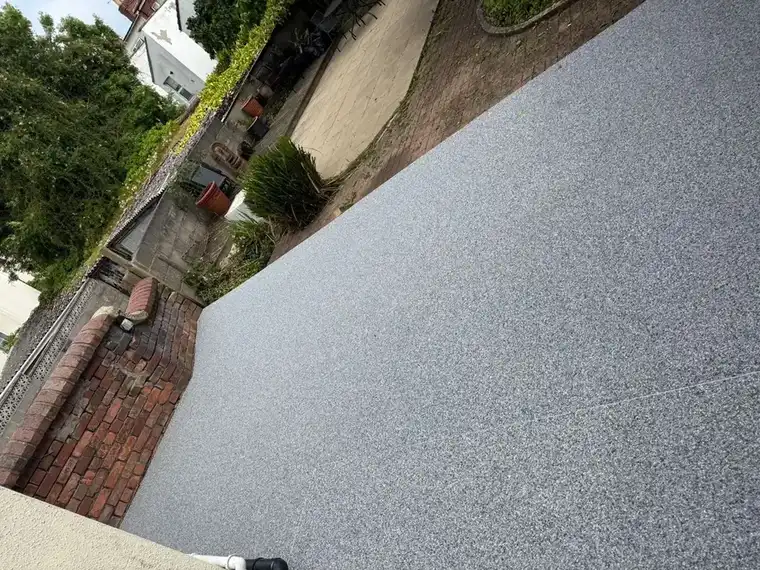
Resin bound surfacing typically runs in the region of £100-£250 per square metre depending on size and groundwork, against roughly £40-£80 for tarmac and £40-£70 for loose gravel. Block paving sits close to resin. So if the only number that matters to you is the one on the quote today, resin loses to tarmac and gravel, and there is no point pretending otherwise. Our full cost guide breaks the figures down by size and ground condition.
That upfront gap is the entire case against resin, and for some people it is decisive. But upfront cost and value are not the same thing, and the whole argument for resin lives in the difference between them.
Lifespan And Whole-Life Cost
This is where resin starts to earn its price back.
A correctly installed resin driveway should last 20-25 years. Tarmac lasts 10-15 and then needs resurfacing, with patching along the way. Loose gravel needs topping up more or less forever. Block paving lasts but needs ongoing attention and can require lifting and relaying where it settles. So the cheaper surfaces are not a one-off cost - they keep asking for money.
Run it over 20 years and the gap narrows sharply. A tarmac drive that cost half as much upfront but gets resurfaced once and patched twice is not half the cost anymore. Factor in the near-zero maintenance of resin - no re-sanding, no weeding, no resurfacing - and the whole-life cost of the two surfaces converges, sometimes to resin’s advantage. The premium buys you two decades of not thinking about your driveway.
Maintenance And Time
Value is not only money. It is also the weekends you do not spend maintaining a driveway.

Resin is about as low-maintenance as a surface gets: sweep it, rinse it, occasionally wash it, and that is genuinely it. No joints for weeds, no sand to top up, no re-sealing (unlike pattern imprinted concrete), no raking (unlike gravel), no resurfacing (unlike tarmac). If you have ever spent a Saturday pulling weeds out of block paving joints or raking gravel back into shape, that difference has a real value that never shows up on a quote. Our cleaning guide shows just how little it actually needs.
On the south coast there is a drainage angle too. Resin is permeable, so it drains rather than puddling and avoids the front-garden planning permission that impermeable surfaces trigger over 5m². On the flat coastal plots common around Bournemouth and Poole, that is worth something practical, not just theoretical.
When Resin Is Not Worth It
Here is the part the sales pages leave out. There are situations where I would genuinely steer you toward spending less.
If you are on the tightest possible budget and cannot comfortably stretch to resin, a well-laid tarmac drive does the job and there is no shame in it - a good cheaper surface beats a resin drive you had to cut corners to afford. If you are selling within a year or two, you will not be around to enjoy the 20-year lifespan, and something presentable and cheaper may be the smarter spend. And for a purely functional area - a rear access strip, the approach to a shed or garage round the back - where nobody is looking and drainage does not matter, resin prices are hard to justify.
There is one more: resin is only worth it if it is installed properly. A resin drive laid on a bad base by the cheapest bidder will fail, and a failed resin drive is worse value than any cheap surface. If your choice is between quality tarmac and bargain-basement resin, take the tarmac. The value in resin is inseparable from the quality of the installation, which is why choosing the right installer matters as much as choosing the surface.
So, Is It Worth It For Your Home?
For most Bournemouth homeowners planning to stay put for several years, on a front driveway they will see every day, resin is worth it. The higher upfront cost buys a surface that lasts two decades, needs almost nothing from you, drains without planning headaches, and keeps the house looking cared-for. Spread over its life, the premium is smaller than it looks on the quote.
It is not worth it if cost is the only factor and you cannot stretch to a quality job, if you are moving very soon, or if the area is purely functional. Those are real situations and a good installer will tell you so rather than push resin regardless. The people who regret resin are almost always the ones who bought a cheap version of it; the people who are glad they spent the money are the ones who had it done properly and then forgot about their driveway for twenty years.
If you want an honest opinion on whether resin is the right call for your specific property and budget - including if the answer is “spend less here” - book a free site visit and we will give you a straight recommendation.
Frequently Asked Questions
Are resin driveways worth the money?
For most homeowners planning to stay in their property for several years, yes. Resin costs more upfront than tarmac or gravel but less to maintain than block paving, lasts 20-25 years, needs almost no upkeep, drains without planning permission issues, and holds its appearance. Over the life of the surface it usually works out good value despite the higher starting price. It is less obviously worth it if you are on the tightest possible budget, planning to move very soon, or surfacing a purely functional area where looks and drainage do not matter - in those cases a cheaper surface can make more sense.
Is a resin driveway cheaper than block paving?
Upfront, resin and block paving are broadly similar, often both in the region of £100-£150 per square metre depending on the job. Over time resin usually works out cheaper because it has no joints to spread, no sand to re-sand, and no weeds to treat, whereas block paving needs ongoing maintenance and can sink or lift where the base moves. So resin is not necessarily cheaper on day one, but its lower running cost tends to make it better value across 15-20 years.
Do resin driveways add value to a house?
A well-installed resin driveway improves kerb appeal and presents a property as well-maintained, which helps at sale - especially in a competitive market. It rarely adds a specific pound figure you can point to, but a tidy, low-maintenance, off-street parking area is a genuine selling point that helps a property show well and move faster. The value is more about presentation and buyer appeal than a fixed uplift. Our separate guide on whether a resin driveway adds value goes into this in more detail.
When is a resin driveway not worth it?
Resin is less worth it if upfront cost is the only thing that matters and you cannot stretch beyond the cheapest option, if you are selling within a year or two and just need something presentable, or if the area is purely functional - a rear access strip or a shed approach - where appearance and permeable drainage are not priorities. It is also not worth paying resin prices for a poor installation on a bad base; a badly laid resin drive is worse value than a well-laid cheaper one. The value depends on a quality installation on a sound sub-base.
How long does a resin driveway last compared to cheaper options?
A correctly installed resin driveway lasts around 20-25 years with minimal maintenance. Tarmac typically lasts 10-15 years and needs patching and eventual resurfacing. Loose gravel needs topping up indefinitely. Block paving lasts a long time but needs ongoing joint maintenance and can require lifting and relaying where it settles. Resin's long, low-maintenance life is central to the value argument - the higher upfront cost is spread over a longer period with fewer running costs than the cheaper surfaces.